Two things determine your life: the quality of your decision…
Two things determine your life: the quality of your decisions and luck. What matters is telling them apart.
Life is more like poker than chess. Because hidden information and luck are involved, even the most careful decision can lead to a bad outcome. So you shouldn't judge whether a decision was right or wrong based on results alone. Learn from results, but keep the result and the quality of the decision separate.
Great decisions come from a good process, not good results. A good decision-maker acknowledges their own uncertainty and tries to predict possible outcomes and their probabilities as accurately as possible.
When you think in probabilities instead of 0% or 100%, you can't say your prediction was wrong just because an unlikely outcome actually happened. This probabilistic thinking means you stop rejecting your entire judgment based on a single bad result.
Every decision is choosing one thing and giving up the rest. Not investing is also an investment, and most investments come down to a fight with yourself.
The problem is that updating your beliefs objectively is harder than it seems. Smart people especially fall into blind spot bias, believing they're not biased. You see other people's biases easily but not your own. When that happens, it helps to actually put something—money or time—behind your beliefs. The awareness that something's at stake softens your claims and brings you closer to the truth.
What you eventually realize is that the future is always uncertain, your certainty is weaker than you think, and there are almost no beliefs that are completely right or completely wrong.
So it's better to map out various possibilities and their probabilities beforehand in concrete terms. You're implicitly predicting the future every time you decide anyway, so don't leave that vague. Make it explicit.
Imagine arriving at your destination and looking back. Picture how you got there beforehand. The more you visualize the future as if you've already lived it, the better your decisions become.
You can add negative visualization to this. Imagine not just achieving your goal but the obstacles that could block it.
Pre-mortem analysis starts here—assume you failed at your goal and ask yourself "why did I fail?" When you think through the reasons for failure in advance, you can prepare for unexpected risks and raise your chances of success.
Good decision-making isn't the ability to predict the future accurately. It's the ability to prepare better for an uncertain future.
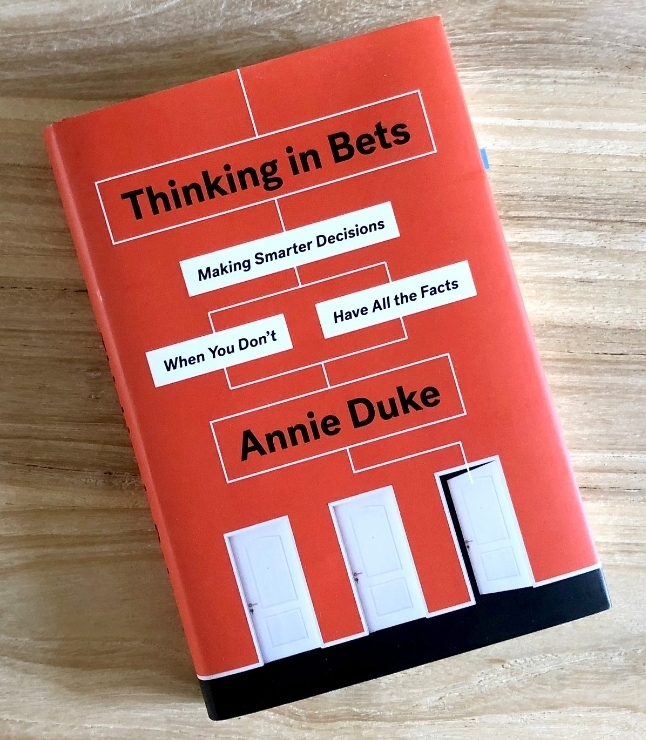
Thinking in Bets by Annie Duke